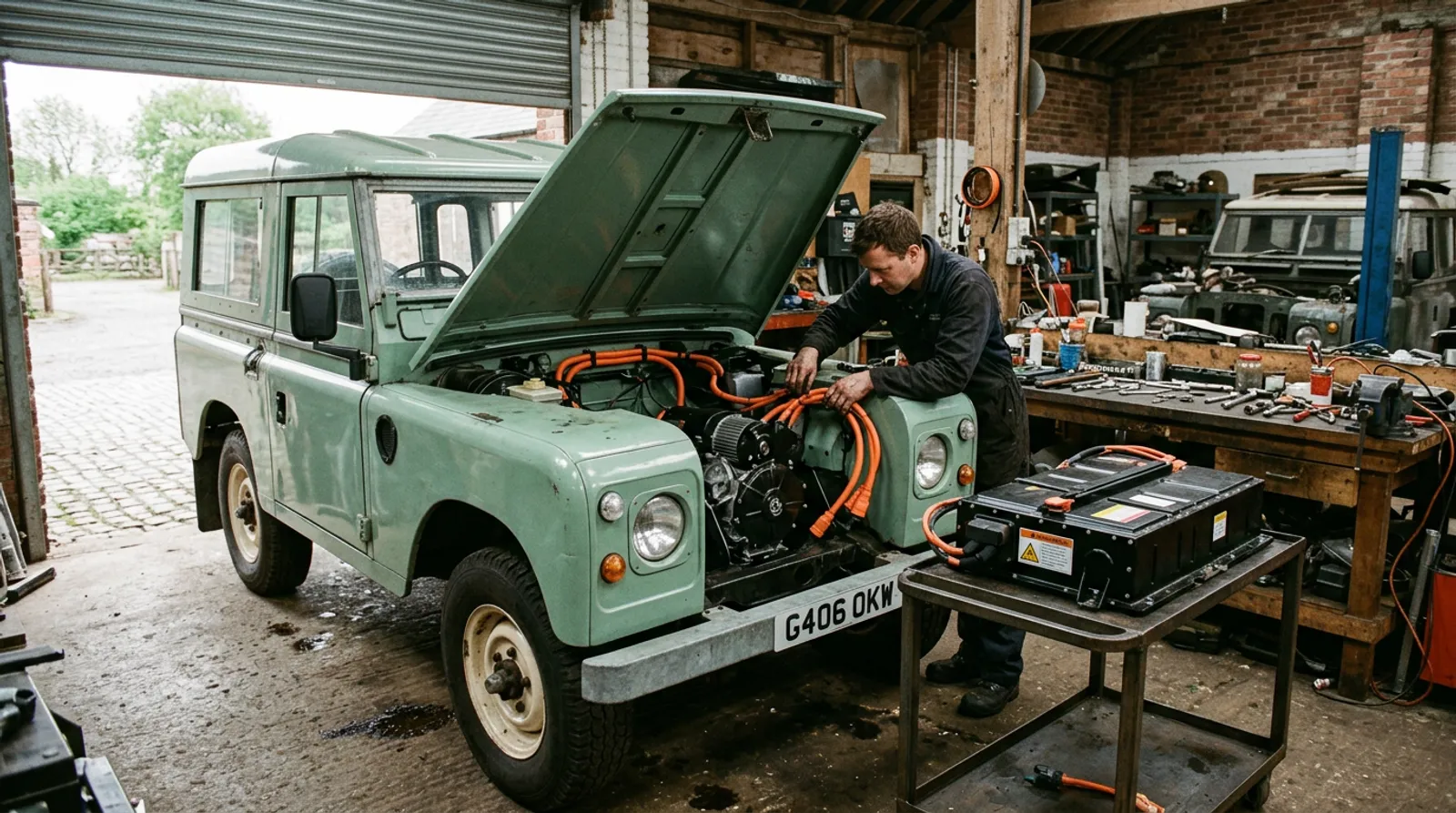
Few vehicles divide opinion like an electric Land Rover. To some owners it is sacrilege: a Series without the clatter of a 2.25 or a Defender without the whistle of a Tdi is simply not the real thing. To others it is the only way to keep using an old Land Rover every day as fuel prices, clean air zones and parts supply all move against it. Both camps have a point, and the right answer depends a great deal on which vehicle you own and what you use it for.
This guide covers the Series I through III, the Ninety, One Ten and 127, and the Defender up to the end of production in 2016, including the military variants. It is written for owners weighing up a conversion, not as a technical manual. Anything involving high-voltage systems should be designed and signed off by a qualified specialist.
What a conversion actually involves
In broad terms the engine, fuel tank, exhaust and usually the radiator come out. In their place go an electric motor, a motor controller (inverter), a battery pack, an on-board charger, a DC-DC converter to run the 12 volt system, a charging socket, cooling for the batteries and motor, and the high-voltage wiring and safety interlocks that tie it together.
Most Land Rover conversions keep the transfer box, and many keep the main gearbox too. Retaining the LT230 (or the Series transfer box) matters because it preserves low range, which is what makes an electric Land Rover so good off road. Some builds drop the main gearbox and run the motor straight into the transfer box, which saves weight and simplifies the driveline but leaves you with just high and low ratios.
There are also knock-on jobs that are easy to forget. Without an engine there is no vacuum for the brake servo, so an electric vacuum pump or an electro-hydraulic brake booster is needed. Power steering on Defenders needs an electric pump. The heater relies on engine coolant, so it needs an electric heater element or heat pump. None of these are hard, but they all add cost and complexity.
The case for going electric
Off-road manners that are hard to beat
An electric motor makes full torque from standstill, cannot stall, and can be controlled to a crawl with the throttle alone. In low range on a steep rocky descent or a slow technical climb, that precision is genuinely better than a diesel, even a good one. Owners who have driven converted Land Rovers at pay-and-play sites tend to come back converted themselves.
Clean air zones and city use
This is the biggest practical argument for later vehicles. A pre-2016 Defender diesel does not meet the Euro 6 standard needed for London ULEZ and similar zones, so it attracts a daily charge. Vehicles over 40 years old in the historic tax class are currently exempt from ULEZ, but a 1990s Defender 90 or 110 is not. For an owner who needs to drive into a zone regularly, an electric conversion can turn a vehicle that costs money every time it moves into one that is cheap to run.
Far less routine maintenance
No oil changes, no injectors, no fuel lift pump, no timing belt, no head gasket, no clutch in a direct-drive build. Many of the faults in our Workshop database simply disappear. The chassis, axles, swivels, brakes and suspension still need the same attention as ever, but the engine bay stops being the main source of trouble.
Quiet, smooth and refined
Anyone who has driven a Series at 50mph for an hour knows how tiring the noise is. Take the engine away and you are left with wind and tyre noise, which on a Land Rover is still plenty, but conversation becomes possible and long drives get much easier. Being able to pass livestock, wildlife or horses silently is a quiet bonus for farm and estate use.
A future that does not depend on fuel or parts
Fuel prices and supply are not getting more predictable, and some engine parts for older units (particularly early petrols and the Td5 electronics) are becoming harder to source in good quality. An electric drivetrain built from modern, widely used components can be a way to keep a vehicle on the road for decades more.
The case against
Cost
This is the hardest hurdle. Professionally engineered conversions from specialist firms typically run from the mid tens of thousands of pounds upwards, before you count the value of the vehicle itself. Bolt-in kits for DIY or local garage fitting are cheaper but still a significant investment, and the battery pack is usually the single most expensive part. On a tired Series that is worth a few thousand pounds, the sums rarely make financial sense. You do it because you want to, not to save money.
Range and charging
A Land Rover has the aerodynamics of a garden shed and is heavy before you add batteries. Realistic range for most conversions sits somewhere around 80 to 150 miles depending on pack size, speed and terrain, and it drops sharply with motorway speeds, towing, cold weather or a day in low range. For local work, school runs and weekend green laning that is fine. For a trip to the Highlands or an overland expedition, a diesel is still far easier.
Weight and payload
Batteries are heavy. A pack large enough for useful range can weigh several hundred kilograms, which often cancels out the weight saved by removing the engine and gearbox, and can push the total higher. That eats into payload, changes the handling, and puts more load on springs, axles and brakes that were never designed for it. Where the pack is mounted matters enormously for weight distribution and ground clearance.
Towing
Towing is one of the things Land Rovers are bought for, and it is where electric conversions are weakest. A trailer or horsebox can cut range in half or worse. Check carefully whether a conversion is rated to tow at all and at what weight, because the insurer and the law will care.
Wading and remote repairs
A well-built pack can be sealed to a high standard, but water, mud and high voltage need serious respect. A Land Rover that wades rivers regularly needs a conversion designed specifically for it, with properly sealed connectors and battery enclosures. And if something does go wrong miles from anywhere, a diesel can often be coaxed home with basic tools. An electric fault usually means a recovery truck and a specialist.
Originality and value
For rare or historically significant vehicles, originality is a big part of their value. Converting an early Series I, a genuine military Lightweight, a Pink Panther or a low-mileage limited edition Defender is likely to reduce what the vehicle is worth to collectors, even if the conversion is excellent. If you are in any doubt, choose a conversion that keeps the original mounting points and store the original engine and gearbox so the work can be reversed.
Pros
- Instant torque and stall-free crawling in low range
- Clean air zone compliant, a big win for later Defenders
- Very little engine-related maintenance
- Quiet and smooth on the road
- Cheap to run per mile if charged at home
- Not dependent on hard-to-find engine parts
Cons
- High upfront cost, rarely recovered on resale
- Limited range, especially at speed, towing or in the cold
- Battery weight reduces payload and affects handling
- Wading and remote breakdowns need careful design
- Can reduce the value of rare or original vehicles
- Insurance, registration and MOT paperwork to sort out
How each model suits conversion
| Model family | Suitability | Why |
|---|---|---|
| Series I | Think twice | Light and simple, which helps range, but early vehicles are increasingly valuable and originality is prized. Reversible conversions only. |
| Series II / IIA / III (88") | Good | Plentiful, simple to work on, and the slow original engines are easily outperformed. The most popular base for classic conversions. |
| Series 109" and One Ton | Fair | More room for batteries but heavier, so range suffers. Better for estate or farm use than long trips. |
| Ninety / One Ten / 127 | Good | Coil springs cope better with the extra weight, and these were often fitted with engines owners are happy to see go. |
| Defender 90 / 110 (Tdi, Td5, Puma) | Very good | Strongest case of all: not ULEZ compliant as diesels, mechanically robust, and well supported by existing conversion kits. |
| Defender 130 | Fair | Payload is the reason most people own one, and battery weight eats into it. Worth it only for a specific use. |
| Limited editions (50th, SVX, Celebration) | Not recommended | Value depends heavily on original specification. A conversion is likely to cost more than it is worth. |
| Military (Lightweight, Wolf, 101 FC, specials) | Not recommended | Historic and collector value is high, and many have provenance that a conversion would undo. |
Paperwork, insurance and the MOT
In the UK, changing the fuel type means updating the V5C with the DVLA, and you should expect to provide evidence of the work. Tell your insurer before the vehicle goes back on the road; many mainstream insurers will not cover a converted classic, so specialist classic or modified-vehicle insurers are usually the answer.
Vehicles over 40 years old can be exempt from the MOT, but that exemption only applies if the vehicle has not been substantially changed. Replacing the engine with a different type of power unit is likely to count as a substantial change, which may mean the vehicle needs an annual MOT again. Rules change, so check current DVLA and DVSA guidance for your vehicle before you start rather than after.
Middle ground options
- Keep the diesel but run it on HVO (hydrotreated vegetable oil), which most older Land Rover diesels tolerate well and which cuts lifecycle carbon emissions, though it does not help with clean air zones.
- Fit a later, cleaner engine if a specific zone standard is the only problem, while accepting this is rarely cheaper than you hope.
- Use the Land Rover for what it does best, off road and in the country, and accept a park and ride for city trips.
- Choose a fully reversible conversion that keeps the original mounts, so a future owner can put the original engine back.
Our verdict
An electric conversion makes the most sense on a later Defender or a common coil-sprung Ninety or One Ten that is used locally, needs to enter clean air zones, and rarely tows. It can also be a joy on a common Series III used for short trips and green laning. It makes the least sense on rare, original or military vehicles, on anything that tows heavily or travels long distances, and on vehicles whose value is lower than the cost of the conversion.
If you are seriously considering it, talk to owners who have done it, drive a converted vehicle before committing, and get the paperwork straight before the engine comes out. Have you converted yours, or decided against it? Tell us why on the forum.
Join the conversation
Agree, disagree or have first-hand experience? Share it with other owners on the forum.
Discuss on the forum