All models
Series III
Series III
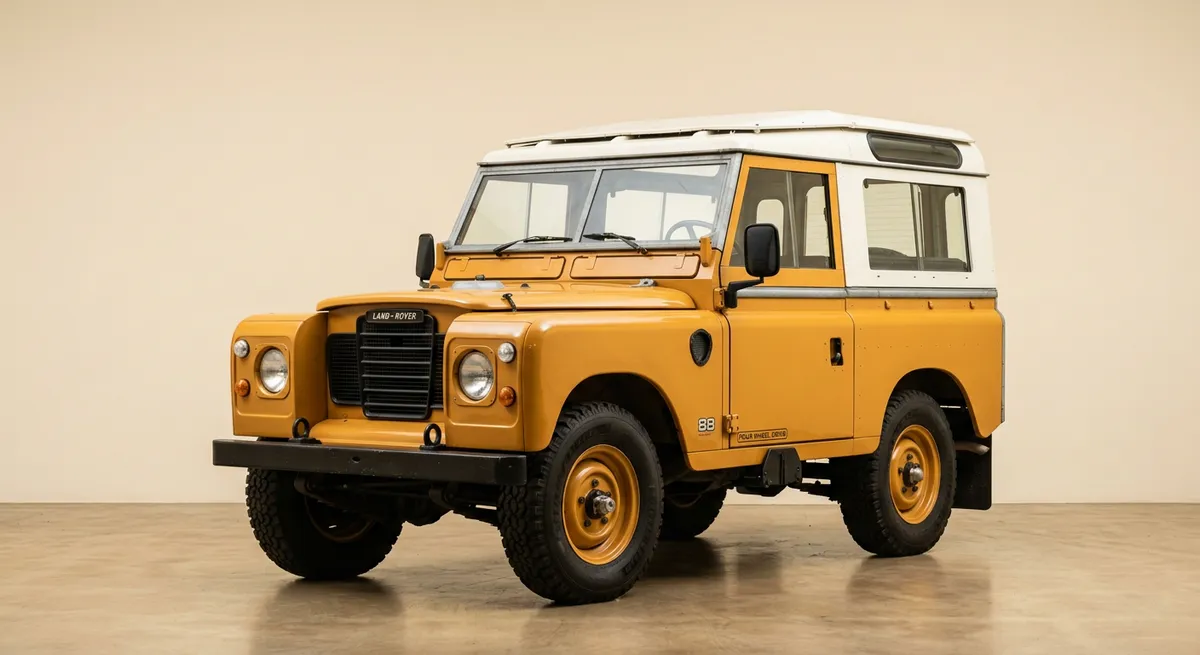
The most numerous Series model, with roughly 440,000 built. It brought an all-synchromesh gearbox, a plastic grille, a padded dashboard and stronger brakes, while keeping the leaf-sprung formula.
- Released
- 1971
- Ended
- 1985
Full technical specification
Figures are typical for the model range and vary by year, engine, body style and market.
Engine
- Type
- 2.25 L petrol, 2.25 L diesel, 2.6 L 6-cylinder petrol (109")
- Displacement
- 2,286 cc / 2,286 cc / 2,625 cc
- Power
- 70 bhp / 62 bhp / 86 bhp
- Torque
- 120 lb ft / 103 lb ft / 132 lb ft
- Later option
- 5-bearing crankshaft engines from 1980
Transmission & drive
- Gearbox
- 4-speed all-synchromesh manual
- Transfer box
- 2-speed, high and low range
- 4WD system
- Selectable 4WD, optional Fairey overdrive
- Final drive
- 4.7 : 1
Chassis & running gear
- Frame
- Welded box-section steel ladder chassis
- Body
- Birmabright aluminium alloy panels on steel bulkhead
- Front suspension
- Semi-elliptic leaf springs, telescopic dampers
- Rear suspension
- Semi-elliptic leaf springs, telescopic dampers
- Axles
- Live beam axles, Rover Salisbury rear on later 109s
- Brakes
- Hydraulic drums, dual circuit and servo assisted from 1980
- Steering
- Recirculating ball
Dimensions & capacities
- Wheelbase
- 88 in (2,235 mm) / 109 in (2,769 mm)
- Length
- 142.4 in (88"), 175 in (109")
- Width
- 66 in (1,676 mm)
- Height
- 77.4 in (1,966 mm)
- Kerb weight
- Approx. 1,460 kg (88"), 1,710 kg (109" SW)
- Fuel tank
- 10 gal (88"), 16 gal (109")
- Ground clearance
- 8.25 in (210 mm)
Performance
- Top speed
- Approx. 68 mph petrol
- 0 - 50 mph
- Approx. 16 s (2.25 petrol)
- Fuel economy
- Approx. 14 - 20 mpg
Production
- Built at
- Solihull, England
- Units
- Approx. 440,000
- Notable
- 1 millionth Land Rover built in 1976 (a Series III)
- Body styles
- Soft top, Hard top, Pick-up, Station Wagon, County