All models
Series I
Series I 80"
Unveiled at the Amsterdam Motor Show in April 1948. Built from aluminium alloy over a box-section steel chassis, it was intended as a stop-gap farm vehicle and went on to outsell Rover cars within a year.
- Released
- 1948
- Ended
- 1953
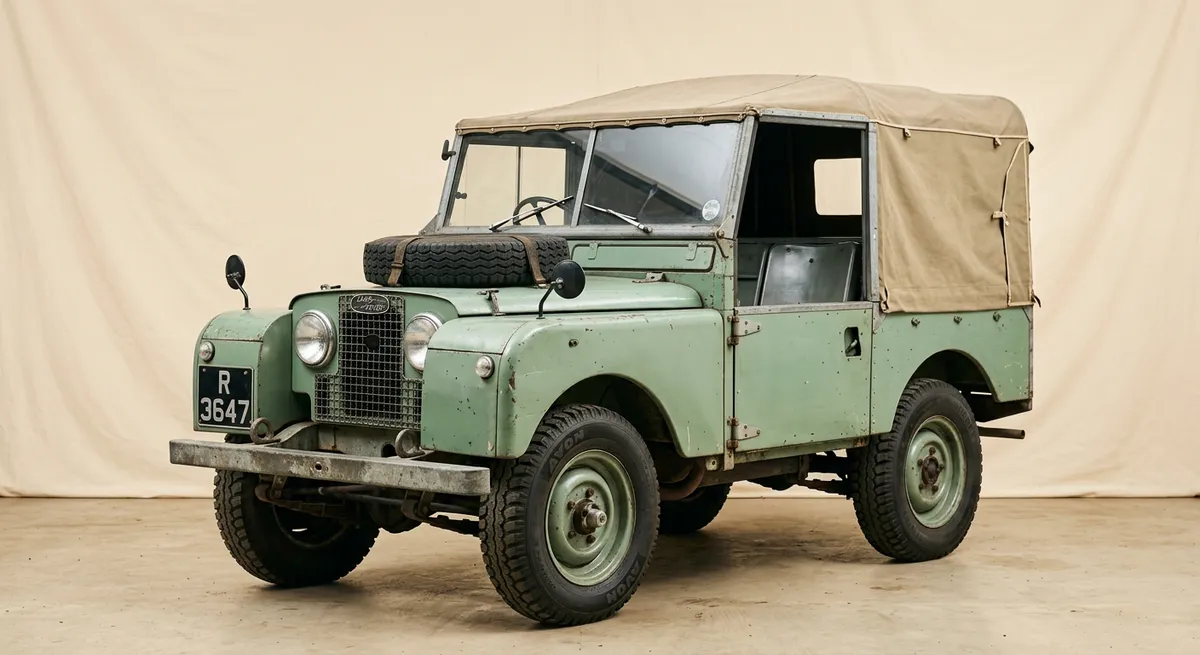
Full technical specification
Figures are typical for the model range and vary by year, engine, body style and market.
Engine
- Type
- Rover inlet-over-exhaust 4-cylinder petrol
- Displacement
- 1,595 cc (1948 - 51), 1,997 cc (1952 - 53)
- Bore x stroke
- 69.5 x 105 mm (1.6 L), 77.8 x 105 mm (2.0 L)
- Power
- 50 bhp @ 4,000 rpm (1.6), 52 bhp @ 4,000 rpm (2.0)
- Torque
- 80 lb ft (1.6), 101 lb ft (2.0)
- Fuel system
- Single Solex carburettor
- Compression
- 6.8 : 1
Transmission & drive
- Gearbox
- 4-speed manual, synchromesh on 3rd and 4th
- Transfer box
- 2-speed, high and low range
- 4WD system
- Permanent 4WD with freewheel (1948 - 50), then selectable 4WD
- Final drive
- 4.7 : 1
Chassis & running gear
- Frame
- Welded box-section steel ladder chassis
- Body
- Birmabright aluminium alloy panels on steel bulkhead
- Front suspension
- Semi-elliptic leaf springs, telescopic dampers
- Rear suspension
- Semi-elliptic leaf springs, telescopic dampers
- Axles
- Live beam axles, Rover Salisbury rear on later 109s
- Brakes
- Lockheed hydraulic drums, 10 in all round
- Steering
- Worm and nut
Dimensions & capacities
- Wheelbase
- 80 in (2,032 mm)
- Length
- 132 in (3,353 mm)
- Width
- 61 in (1,549 mm)
- Height
- 73.5 in (1,867 mm), hood up
- Kerb weight
- Approx. 1,180 kg
- Fuel tank
- 10 gal (45 L), under driver seat
- Tyres
- 6.00 x 16
Performance
- Top speed
- Approx. 50 - 55 mph
- Fuel economy
- Approx. 18 - 20 mpg
Production
- Built at
- Solihull, England
- Units
- Approx. 218,000 Series I across all wheelbases
- Launched
- Amsterdam Motor Show, 30 April 1948
- Body styles
- Soft top, Tickford Station Wagon, Pick-up